First string quartet
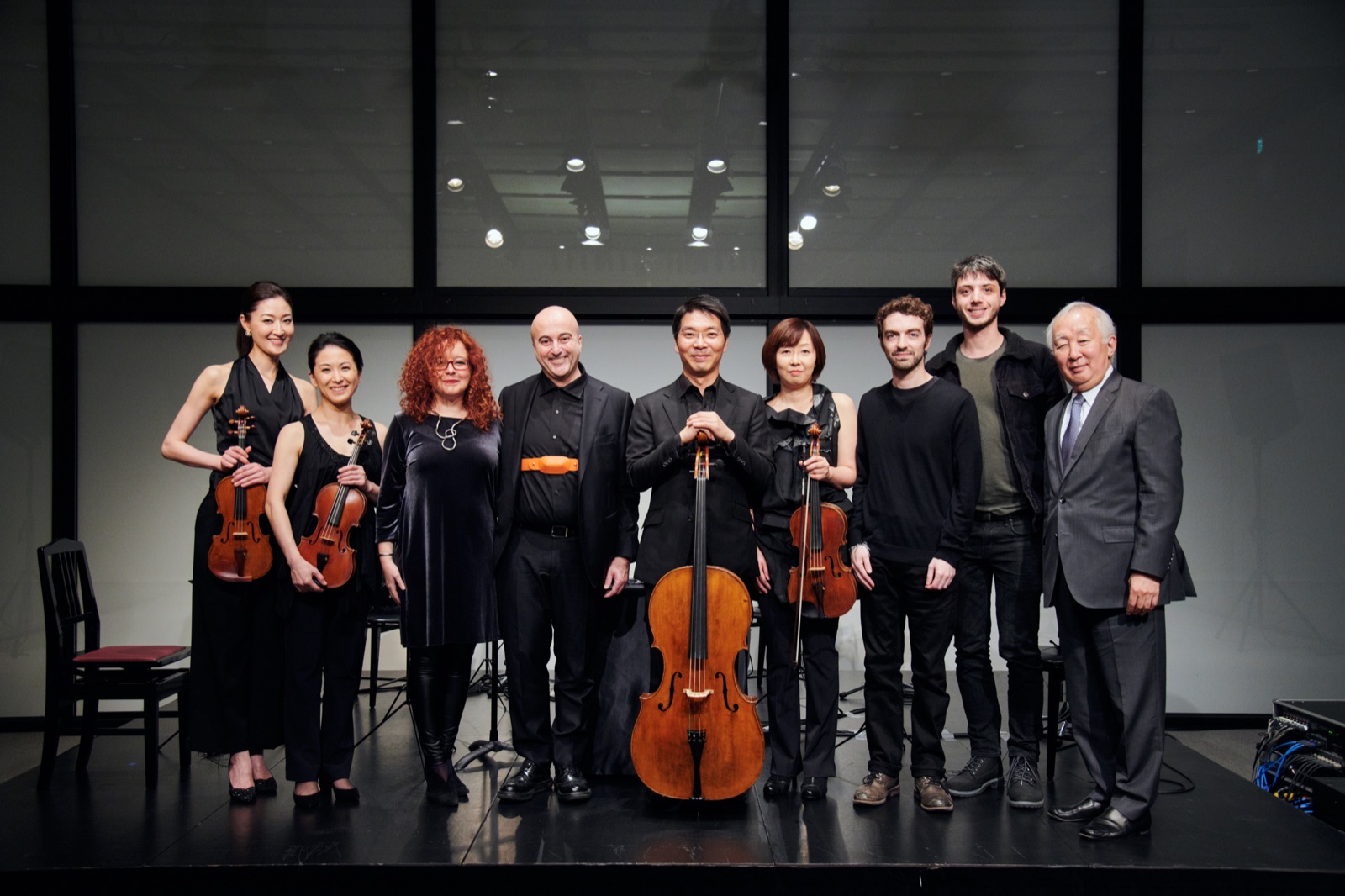
Il colore del Blu belongs to a double cycle. It is Baboni Schilingi's first string quartet and at the same time the fourth composition in a cycle of five musical pieces dedicated to colours: Il colore del buio. Each composition in this cycle is inspired by a specific colour, in this case blue.
The first draft of this quartet dates back to 1994, for the examination paper for the diploma in composition. In Italy, in fact, there was the tradition of writing a first section of a string quartet in 36 hours. In 1999, when Baboni Schilingi received a commission from the Ensemble Intercontemporain, he decided to finish this first quartet of his by naming it Il colore del Blu.
This quartet represents the end of the studies by Baboni Schilingi and the beginning of his independent career. In the writing, the unity of the material is given by the choice of 5 chords [each chord is associated with the 5 colours of the entire cycle of the five compositions]. These 5 chords [which recur throughout the cycle] derive from the harmonic fields formalised by Elliott Carter [omni-interval chords] and Karlheinz Stockhausen and are clearly displayed in the first minute of the quartet. These five chords are reworked with the technique of frequency shifting that Baboni Schilingi studied with spectral composers in Paris. In fact, the entire string quartet represents an integration of the techniques of the Italian school coming out of Franco Donatoni, the techniques of the spectral school of Gerard Grisey and Hugues Dufourt, and the techniques of using the constraints and rules of the Finnish school of Magnus Lindberg. More specifically, Baboni Schilingi from 1993 to 1997 himself developed innovative techniques based on the application of precise rules but applied in a 'heuristic' manner. For example, from minute 2:29 to 4:08, Baboni Schilingi uses a technique he himself developed: dynamic interpolation, which allows a material to be continuously and uniformly transformed from a starting point and an end point by following hand-drawn curves.
Following in the tradition of Ravel, Baboni Schilingi dedicates his first quartet "to his master" [Ivan Fedele] and he considers this work as a Flemish 'still life’ [natura morta]. In the past, the still lives of Flemish painters had the function of a catalogue of techniques in the service of expressiveness. Baboni Schilingi decided to pay homage to the Academy with this quartet using permutations, combinations, substitutions coming from the Italian school, 'noisy' instrumentation in the footsteps of Ligeti, Sciarrino and Lachenmann, translation of pitches in the footsteps of the French spectral school the techniques he himself developed on dynamic interpolations, integrations and derivations.
The main part is entrusted to the second violin, which opens and closes the quartet.