Piano and live computer
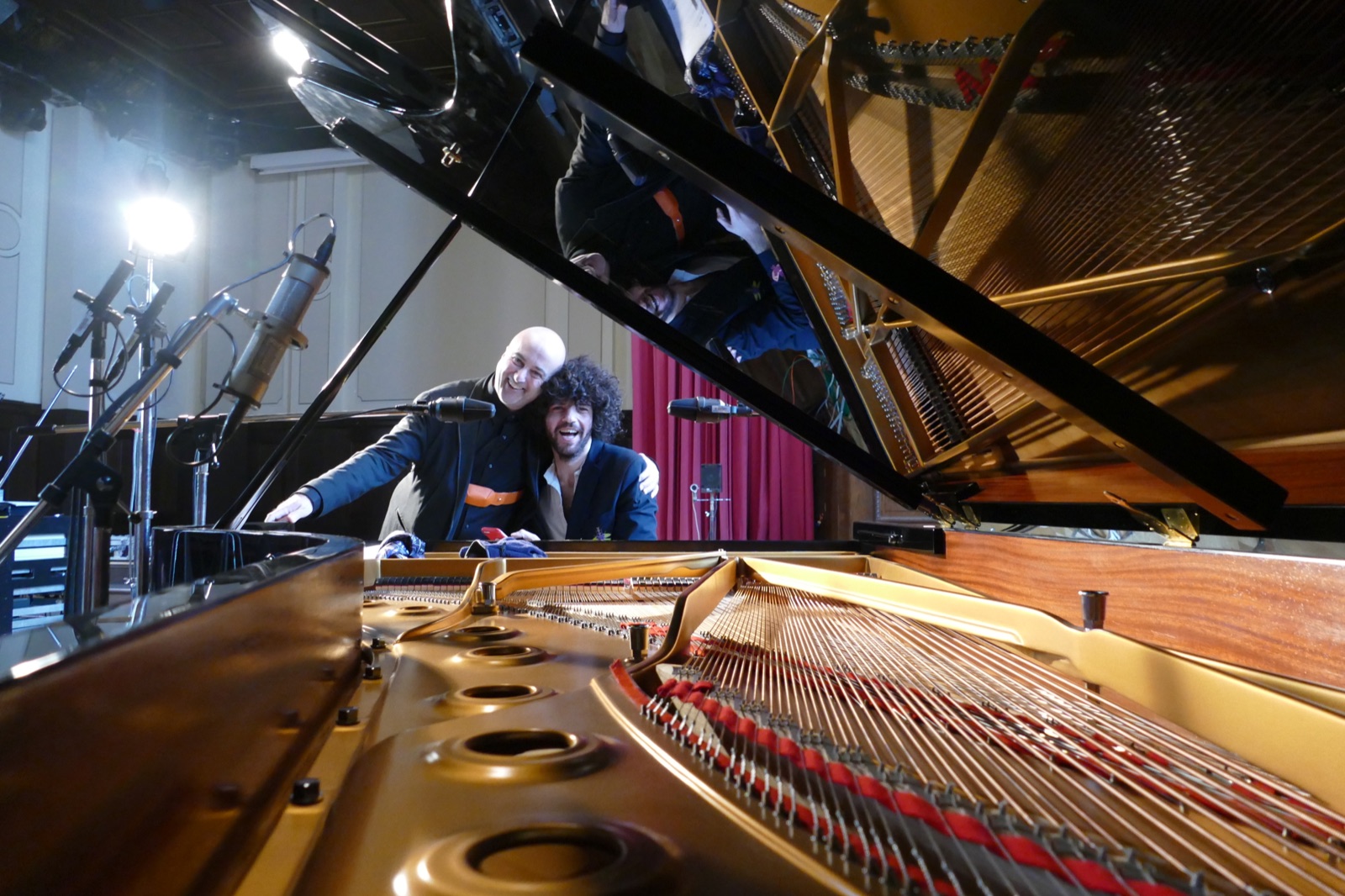
For years, Jacopo Baboni Schilingi has thoroughly explored keyboard sonatas and sonata form, from Scarlatti to contemporary compositions, including the works of his mentor Luciano Berio. Among the sonatas he has analysed extensively are three by Scarlatti [K18, K141, K525], Beethoven’s Op. 111, Liszt’s Sonata in B minor, Schubert’s Sonata in A major, and Luciano Berio’s Sonata. He has also drawn inspiration from several piano études and other keyboard works: Chopin’s Op. 25 No. 12, Liszt’s Études d’exécution transcendante Nos. 2 and 8, Rachmaninov’s Étude-Tableau Op. 39 No. 8, Stockhausen’s Klavierstück IX, and Ligeti’s eighth étude, Fém.
His research has extended to the analysis of several major concertos, including Mozart’s K466, Beethoven’s Concertos Nos. 1, 3, and 5, Schumann’s Concerto, Prokofiev’s Concertos Nos. 3 and 5, Tchaikovsky’s First Concerto, and Rachmaninov’s Second Concerto. A particularly important reference is the first movement of Brahms’s Second Piano Concerto.
He has also found inspiration in the piano four-hands versions of Stravinsky’s Petrushka and The Rite of Spring.
His Sonata contains explicit references [some large-scale, others more subtle] that listeners familiar with these works can discover and recognise.
Although Baboni Schilingi waited until after turning 50 to publish the Sonata, he began writing it in 1996, at the age of 25. He considered the first version, completed between 2000 and 2001, a complete failure and decided to withdraw it entirely from his repertoire. After many years of experimentation and revision, however, he no longer hesitates to call the composition a “Sonata”. In his view, a work bearing this title should engage with the defining elements of sonata form: thematic exposition, repetition, development, modulating transitions, and recapitulation. In this Sonata, all thematic elements undergo exposition, development, and recapitulation.
The Sonata aligns with the aesthetics of consubstantial art, bringing together the emotional, rational, and irrational dimensions of human intelligence. It combines traditional piano techniques with twentieth-century approaches, such as prepared piano and playing inside the instrument. These are enhanced by algorithmic intelligence operating in real time, transforming every gesture of the pianist into an “augmented” experience.
Watch the performance
Veronique Ngo-Sach-Hien
Veronique Ngo-Sach-Hien was born in Paris and started piano lessons with Jacqueline Pouillard at the age of seven. In 1985, Veronique was admitted to ‘Le Conservatoire National Superieur de Paris’ where she studied with Christian Manen, Yvonne Loriod, and Michel Beroff for piano and Anne Grapotte for Chamber music. Ultimately she obtained a ‘Premier Medaille’ for advanced Solfege and first prizes for Piano, Chamber Music and Vocal accompaniment.
Between 1998 and 2000, Veronique pursued post graduate studies for Chamber music and, simultaneously, advanced piano with Irina Zaritskaya at the Royal College of Music in London where she obtained the First prize for the Kathleen Long Chamber Music award as well as the Norris Price award, Second prize for the Kendal Taylor award, and the RCM advanced post graduate diploma with honours.
Veronique has also performed in master classes given by Paul Badura-Skoda, Nikita Magaloff, Maria Curcio and Murray Perahia. She also studied with Roger Muraro, Denis Pascal, Pierre Reach, Eliane Richepin, Monique Deschaussées, and Colette Zérah. As a participant of the course for piano accompaniment directed by Ruben Lifschitz at Royaumont Abbey, Veronique had occasion to accompany the Mezzo Soprano Monique Simon. A further intensive course for accompaniment and Lieder studies was undertaken at the Frankfort Music Hochschule, directed by Rainer Hoffman and Charles Spencer during which she encountered such eminent figures as Christa Ludwig, Tabea Zimmerman, Noel Lee and Gerard Sousay.